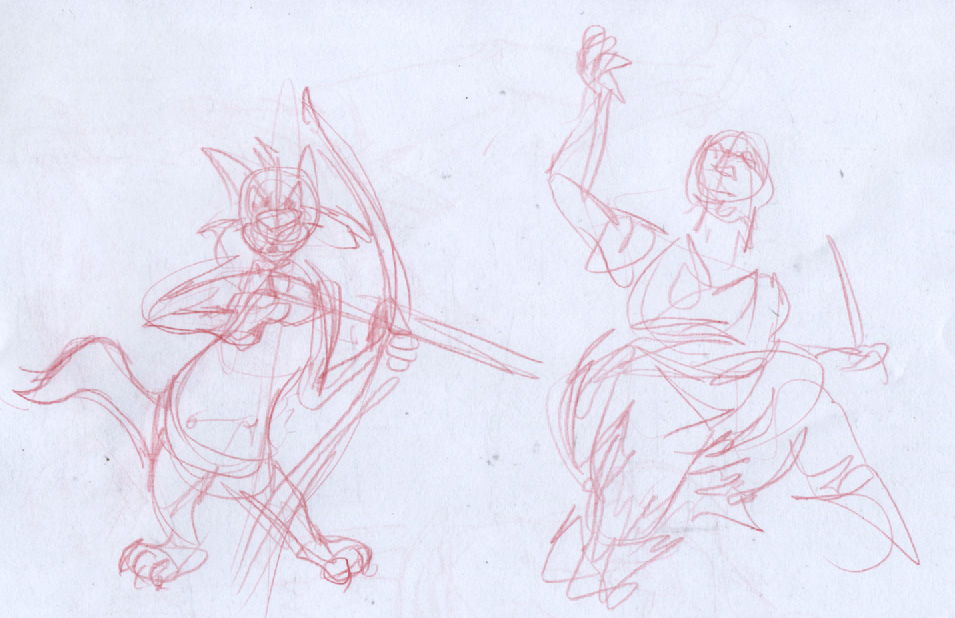
For anyone interested in applying to Capilano's Commercial Animation Program, This is my portfolio that got me admitted into the program.
Figure Drawing - 3 to 5 minute drawings. These were done with a china marker on newsprint. I was focusing on expressive use of line.
Figure Drawing - 3 hour studies - The first two were done in colored pencil on sketch paper. The Other two were done in black and white conte crayon on craft paper. I was focusing on as realistic a representation I could.
Hand Drawings - 20 minutes - These were done in colored pencil on sketch paper, again focusing on as realistic a representation as I could.
Gesture of the Moving Model - These were done either in china marker on newsprint or ball point pen on sketch paper. I wasn't focused on anything except capturing as much as I could as fast as I could since the model was in constant motion.
Sketchbook Drawings - These were either done in ball point pen or ebony graphite pencil on sketch paper. I found various public venues where I could sit and draw people going about their lives. Sometimes they would hold still for long enough, but more often I would draw what I could and then finish the rest from imagination after they moved on. The last drawing is an entire scene I drew in pencil and finished the line work in marker. Throughout the process of preparing my portfolio, this is the exercise I feel did the most for my artistic growth. I highly recommend all artists devote some time to this type of study.
Perspective Drawings - These were drawn on location with mechanical pencil using point to point technique. Then, I went home and traced a new drawing over the original sketches using a ruler to place a horizon line and vanishing points to make the perspective theoretically correct. Finally the line work was finished with marker.
Arm Anatomy - These were drawn in colored pencil on sketch paper. For this study I drew my own arm in the mirror then used Jeno Barcsay's Anatomy for the Artist as a reference to identify the bones and muscles. Using my own arm as a reference allowed me to show my knowledge of anatomy without copying directly from a textbook. It was a humbling exercise because I discovered I did not know the anatomy of the arm as well as I had thought. I have since developed this method of study further and will write about it soon.
Dog Drawings - As with the sketchbook drawings, I worked in ball point pen and ebony graphite pencil on sketch paper. I spend hours drawing in the dog park. Since dogs will not pose for you, I had to learn to capture the basic action of the dog's pose then fill in the rest from imagination. To do this I needed to really know what dogs look like down to the structure and anatomy. Joe Weatherly's The Weatherly Guide to Drawing Animals was a great help in this. Still, it took me weeks before I could get anything that looked decent.
Dog and Horse Anatomy - These were done in pencil on sketch paper. I studied the Anatomy of the animals in Joe Weatherly's Weatherly Guide to Drawing Animals then applied what I know while observing the animals themselves.
Cartoon Characters - If you look in the blog archive you will see I have been drawing in this style for years. The color drawings were cleaned up using Illustrator and Photoshop. The eight drawing turnaround were done to show that I understand the characters in three dimensions.
Thursday, April 28, 2011
Knowledge and Practice: Purpose of this blog
This blog is dedicated to art studies. The purpose is to determine what studies lead to improvement of one's artistic ability. I will be the test subject to determine, as empirically as possible what studies work and what do not. I am not an authority on art instruction, nor have I ever been a teacher or tutor. I am just a man who has dedicated years to the improvement of my artistic ability. As a self-taught artist, I have learned first hand what studies have worked for me and what has been less effective. It is my hope that by keeping detailed records of my studies I will provide a valuable resource for artists and instructors. I also hope others will contribute with critiques and studies of their own. Ideally this will be a place we can all help each other grow artistically.
I will report on my studies in as much detail as possible. I will report the medium I used, the model or subject, the process, and the amount of time it took. Most importantly, I will discuss the purpose of the study. Purpose is what separates a study from any other work of art. I will include the knowledge I am applying to the study, and what I how I hope to improve as a result. My goal is that an artist on the other side of the world would be able to recreate the study provided they had access to similar materials and subjects. This way one can critique not only the final piece but the process that went into producing it.
I believe improvement in artistic ability requires two elements: knowledge and practice. Knowledge meaning an artistic concept such as: anatomy, perspective, or construction. Practice is the experience of using the concept until it becomes integrated into ones ability. Real improvement cannot happen with the absence of either element. One can practice many hours and see improvement. However, without integrating new knowledge into ones practice improvement will stagnate. Repeating the same practice indefinitely will lead to the same results. Conversely, knowledge does not lead to improvement without putting it into practice. One can memorize the names and placement of all the muscles and bones in the human body, but without practice drawing them, this knowledge will be of little use. In my studies I am to focus on the meeting of these two elements where knowledge is put into practice and becomes ability.
Saturday, August 7, 2010
Digital Painting
I took a month or so break from working on my cartoon project to study digital painting. When working on my cartoon project I had become overly focused on line art at the expense of rendering form with color and value. I did tutorials from the book Digital Character Painting Using Photoshop CS3 by Don Seegmiller. I enjoyed this book because it focused more on artistic fundamentals in character desgin rather than digital tricks yet still included some tricks I've been able to apply effectively in my own work. I also did Xia Taptara's Female Fusion Figure I tutorial. This was good because you can watch his drawing develop in real time, however his explanations of what he was doing and why are rambling and often lacked clarity. Overall I am very glad I took spent time working on this. I feel like I improved a lot not only in my skill with photoshop but in my over all artistic ability. Ultimately digital painting is just another medium and the better an all-around artist I am the better my digital painting will be.
My results from Digital Character painting tutorials


Female Fusion Figure Tutorial embarrassingly bad
Other digital painting work
This one is another rendering of the human figure from imagination like the ones I had been doing before. However, with this one I did not map out every muscle in detail before adding the value and color as I had been doing before. Drawing out the anatomy in detail from imagination is a great way to really learn anatomy, however I feel like once you get it, you no longer have to draw out every muscle. Infact, it looks more natural if you don't in most cases as long as you understand that the muscle is there. I've also stopped drawing out every muscle in figure drawing from life too because most people don't have highly defined muscles.
I did this lizard warrior type creature before doing any tutorials to establish my digital painting skill going into it. I hope you can see improvement.


My results from Digital Character painting tutorials


Female Fusion Figure Tutorial embarrassingly bad
Other digital painting work
This one is another rendering of the human figure from imagination like the ones I had been doing before. However, with this one I did not map out every muscle in detail before adding the value and color as I had been doing before. Drawing out the anatomy in detail from imagination is a great way to really learn anatomy, however I feel like once you get it, you no longer have to draw out every muscle. Infact, it looks more natural if you don't in most cases as long as you understand that the muscle is there. I've also stopped drawing out every muscle in figure drawing from life too because most people don't have highly defined muscles.
I did this lizard warrior type creature before doing any tutorials to establish my digital painting skill going into it. I hope you can see improvement.

Tuesday, August 3, 2010
Studies and Noah Hulihan
I've been falling behind on posting my studies. These are mostly about a month old. It takes time to go through my work, select the best, and scan and post them. I would rather spend this time doing more studies.
Another Comedian Approached me to caricature him. This is the very funny Noah Hulihan. I am happy with the caricature but a little disappointing with the way the hair turned out.
Figure Drawing

Gesture


Figure from imagination I did these figures from imagination with a mechanical pencil using a very similar method to the way I was doing figures from life. I found it helped a lot.

Minute Cartoons


Another Comedian Approached me to caricature him. This is the very funny Noah Hulihan. I am happy with the caricature but a little disappointing with the way the hair turned out.
Figure Drawing

Gesture


Figure from imagination I did these figures from imagination with a mechanical pencil using a very similar method to the way I was doing figures from life. I found it helped a lot.
Minute Cartoons


Subscribe to:
Posts (Atom)